
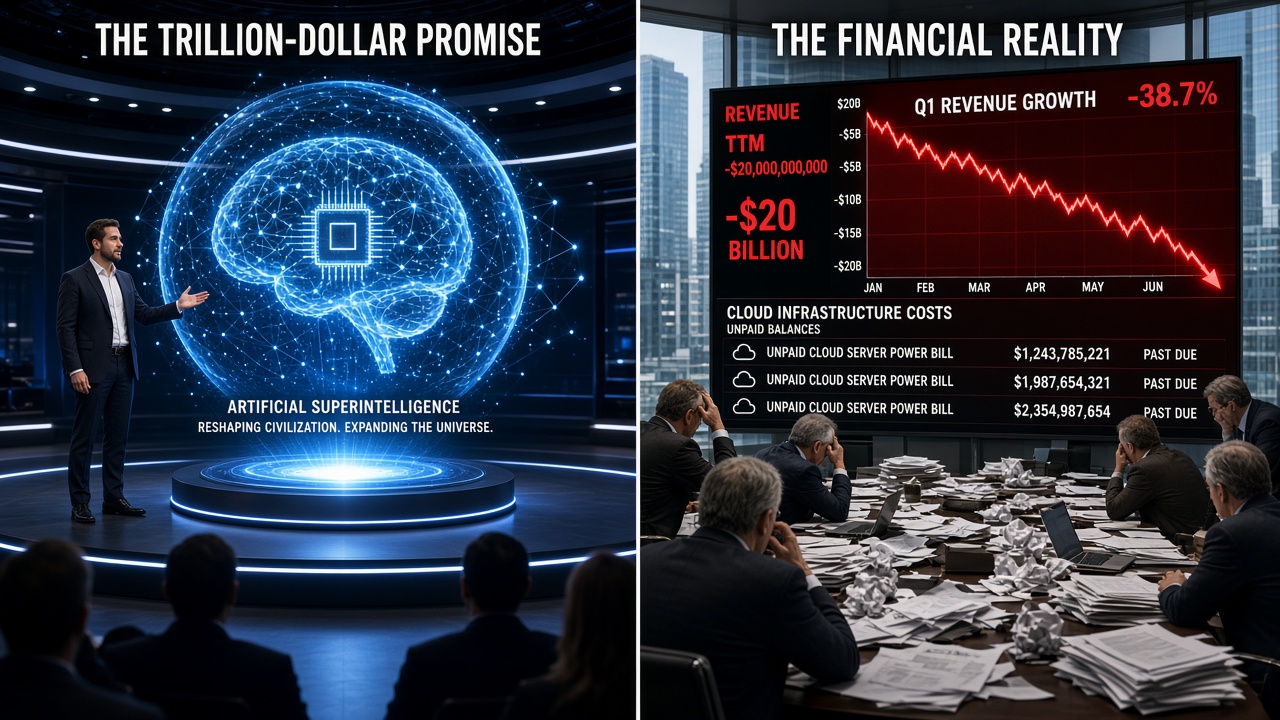
The $20 Billion Question: OpenAI Projects Record Revenues While Burning Astounding Capital on Compute
Pitching trillion-dollar AGI to investors while bleeding twenty billion dollars a year on cloud contracts.
Summary
- Financial models circulating among institutional investors reveal OpenAI projects an operational loss exceeding $20 billion annually against soaring infrastructure and cloud compute costs.
- Despite achieving unprecedented consumer brand recognition, the capital expenditure required to train and run frontier reasoning models continues to outpace enterprise software revenues.
- Venture backers continue underwriting massive multi-billion funding rounds at historic valuations, betting on autonomous economic displacement before liquidity runs thin.
- Wall Street analysts are raising sharp questions about long-term unit economics, comparing the astronomical capex burn to historical telecom infrastructure overbuilds.
Commentary
In Silicon Valley pitch decks, the promise is always cosmic: artificial general intelligence running civilization by decade's end. In the accounting ledger, however, electricity meters and server leases do not accept cosmic promises.
Burning through twenty billion dollars a year to generate summaries and conversational replies is not a margin business—it is a public utility run with private risk capital.
The gap between hype and unit economics is where financial gravity eventually takes its toll. When compute bills arrive monthly in hard currency, even the smartest model must eventually show a path to solvency.
Comments
No company in modern history has ever sustained twenty billion in annual losses without sovereign backing.
Every inference prompt burns GPU power and cooling water. The unit costs simply do not compress like software.
Whoever cracks automated agent workflows captures the entire global white-collar payroll. That is why they fund it.
Remember the fiber-optic bust in 2001? Beautiful tech, catastrophic balance sheets.
Nvidia makes the cash; model labs burn it on electrical bills. Simple arbitrage.
Twenty billion in negative cash flow requires continuous unicorn valuations just to meet payroll.